

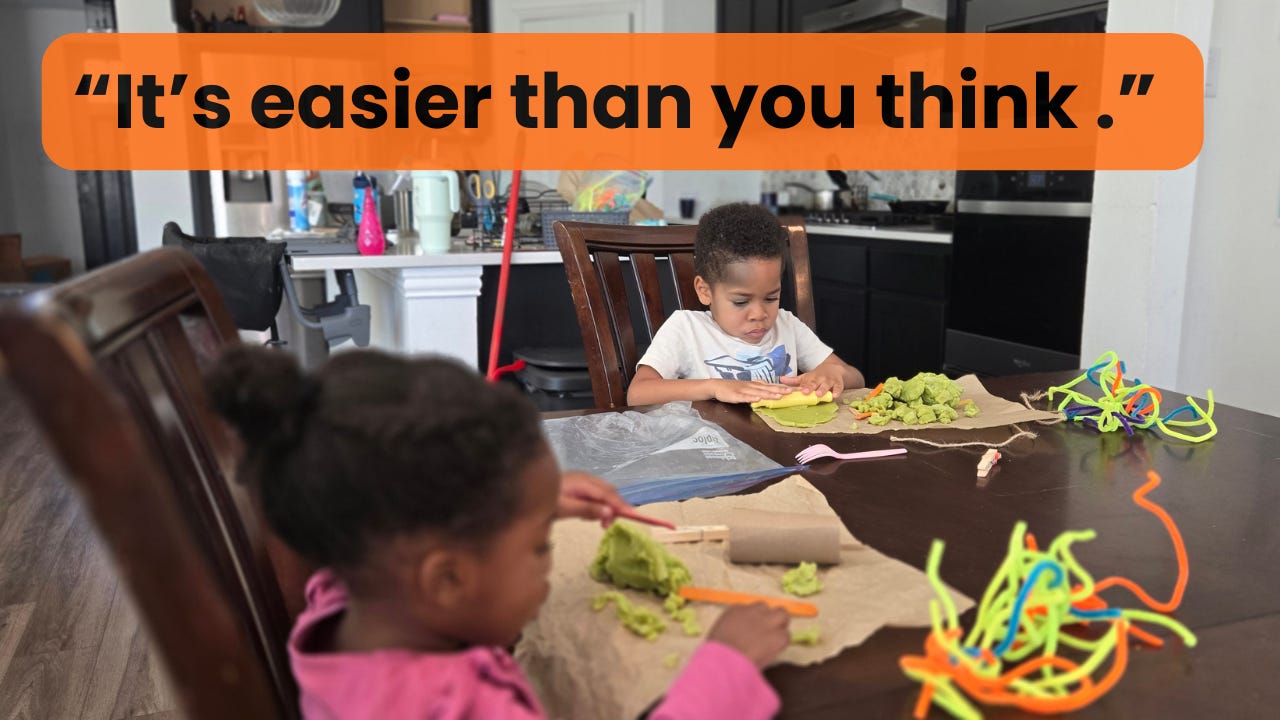
What are you supposed to do all day with your toddler?
I remember feeling this exact way when I had two under two. Library storytime was great... the first dozen times. The park was fun... until you’ve been to every park in a 10-mile radius twice. After a while, the same rotation starts to feel mind-numbingly mundane.
So I thought, “Maybe I should start teaching them something?” But I had no idea where to start. What does preschool even look like at home? Do I need workbooks? A curriculum? Am I qualified to do this?
Fast forward to now, I’m 11 years into this stay-at-home mom life, homeschooling 6 kids with toddlers still in the mix. And here’s what I’ve learned: doing preschool at home is way simpler (and more fun) than you think.
You don’t need money or fancy materials. You definitely don’t need to turn into a teacher.
Here are three easy ways to start preschool at home this week—maybe even today.
1. Start With Your Child’s Interests
This is hands-down the most important thing for these ages.
Just today, my four-year-old and I were playing with some old diaper boxes. I suggested we make a car, and then casually asked, “Can you count these boxes?”
His response? “Ugh, I don’t want to do school.”
Busted. He saw right through me.
After noticing him stepping into the boxes, I said, “Okay, as you step into the box, I’ll count?” Suddenly, he was stepping into boxes, my two-year-old was sitting in them, and we were all counting together. That small tweak made counting less school-like again.
Here’s the kicker: later that evening, he grabbed the TV remote, sat next to me, and said, “I want to count the buttons on this remote.”
So we counted. Then he asked what each button was for. That silly little moment? Was learning too.
Why This Works
Your toddler doesn’t care about arbitrary learning goals. They care about things that are useful or interesting to them.
Think about it this way: if I put you in a classroom to learn about a subject you absolutely hate, you’d be bored out of your mind. But if someone said, “I’m going to show you how to make a million dollars in one hour,” you’d sit in the front row taking notes.
Your preschooler is the same way.
That’s why the kitchen is so fascinating to him. He knows tasty food comes from there, and he wants to learn to make meals for himself.
Whatever you’re teaching, make sure it connects to something they already care about.
2. Have Fun and Add Variety
Preschool doesn’t have to look like worksheets and flashcards. (Honestly, it probably shouldn’t.)
Think: art, nature walks, building things, pretend play, music, exploring textures, making messes.
One day, you can teach about animals. The next day, you’re looking at different types of trees. Then maybe you’re naming car parts or sorting buttons by color. Kids this age love learning. They’re naturally curious about everything.
The only time they’ll shut down is when it becomes dry, repetitive, or forced.
Keep it playful. Keep it varied. Keep it interesting.
You might be thinking, wouldn’t all this random learning get scrambled in my preschoolers’ heads? Well, the short answer is no.
As a baby, all humans initially learn in a random state; it’s only until formal education comes that everything is divided into subjects.
A human brain’s learning works somewhat like a highway system. The more paths your brain has, the more established that information becomes. As humans, we are able to create our own connections between subjects, which is the learning part.
3. Take Care of Their Basic Needs First
This one sounds obvious, but it’s easy to forget when you’re trying to “do preschool.”
Before you try to teach your toddler anything, ask yourself:
Did he get enough sleep last night?
Does he still need a nap today?
Is she getting a reasonably balanced diet—not just sweets all day?
Has she had a chance to move her body and get some fresh air?
I’m not talking about making your child run laps around the backyard. Some kids are naturally high-energy movers. Others are more explorers and observers. Both are fine.
But if your toddler hasn’t been outside, eaten real food, and is tired? Good luck getting her to focus on colors, letters, or counting.
Meet your child’s physical needs first. Then the learning happens naturally.
What a Real Preschool Day Actually Looks Like
Okay, so you might be thinking, “This all sounds great, but what does this actually look like in practice?”
Let me share what our preschool days looked like when I was pregnant with my fourth child and had three kids under four years old. (Yes, you read that right. Three under four. It was... a lot.)
Our Simple Preschool Routine
Morning: After breakfast, we’d head to a local park. Just swings, slides, fresh air, and a chance for them to burn energy.
Midday: We’d come home around lunchtime (or sometimes I’d pack a lunch and we’d eat at the park).
After lunch: This was my favorite part. I’d grab a stack of library books, and we’d all snuggle together on my king-size bed or pile onto the couch. I’d read aloud while they settled down.
This naturally led to naptime. (Thank goodness.)
Afternoon: As each child woke up from their nap, I’d give them a simple snack, like banana slices, apple chunks, nuts, whatever was easy.
Then we’d do a little “focused learning” time. I had a small easel set up, and we’d work on letter sounds or counting. Nothing long, maybe 10-15 minutes.
Late afternoon: This was our “messy learning” time.
Some days I’d take them into the backyard for nature play. They would play with beans, water, and little containers to pour and scoop. Other days, we’d stay inside, and they’d freely paint pictures. And that was it. That was our preschool day.
The Three Key Components of a Good Preschool Day
Looking back, I realize our days always included these three things:
1. Outside play – Fresh air, movement, exploration
2. Messy play – Sensory experiences, creativity, hands-on learning
3. Focused learning time – Letters, numbers, colors, shapes (but kept short and playful)
And here’s the beautiful thing: these three components can be done in so many different ways.
You don’t need my exact routine. But if you can hit those three things most days, you’re doing preschool at home.
That’s It. That’s Preschool at Home.
You don’t need to have a perfectly curated Instagram-worthy learning space or curriculum.
You just need to:
Follow their interests
Keep it fun and varied
Make sure they’re fed, rested, and not glued to a screen
Start this week. Start today, even.
And if you want more in-depth ideas on what preschool at home can actually look like day-to-day, I’ll be sharing more about that soon.
You’ve got this. Your toddler is learning more than you think, even on the days that feel boring or chaotic. Trust yourself.